Business - SME
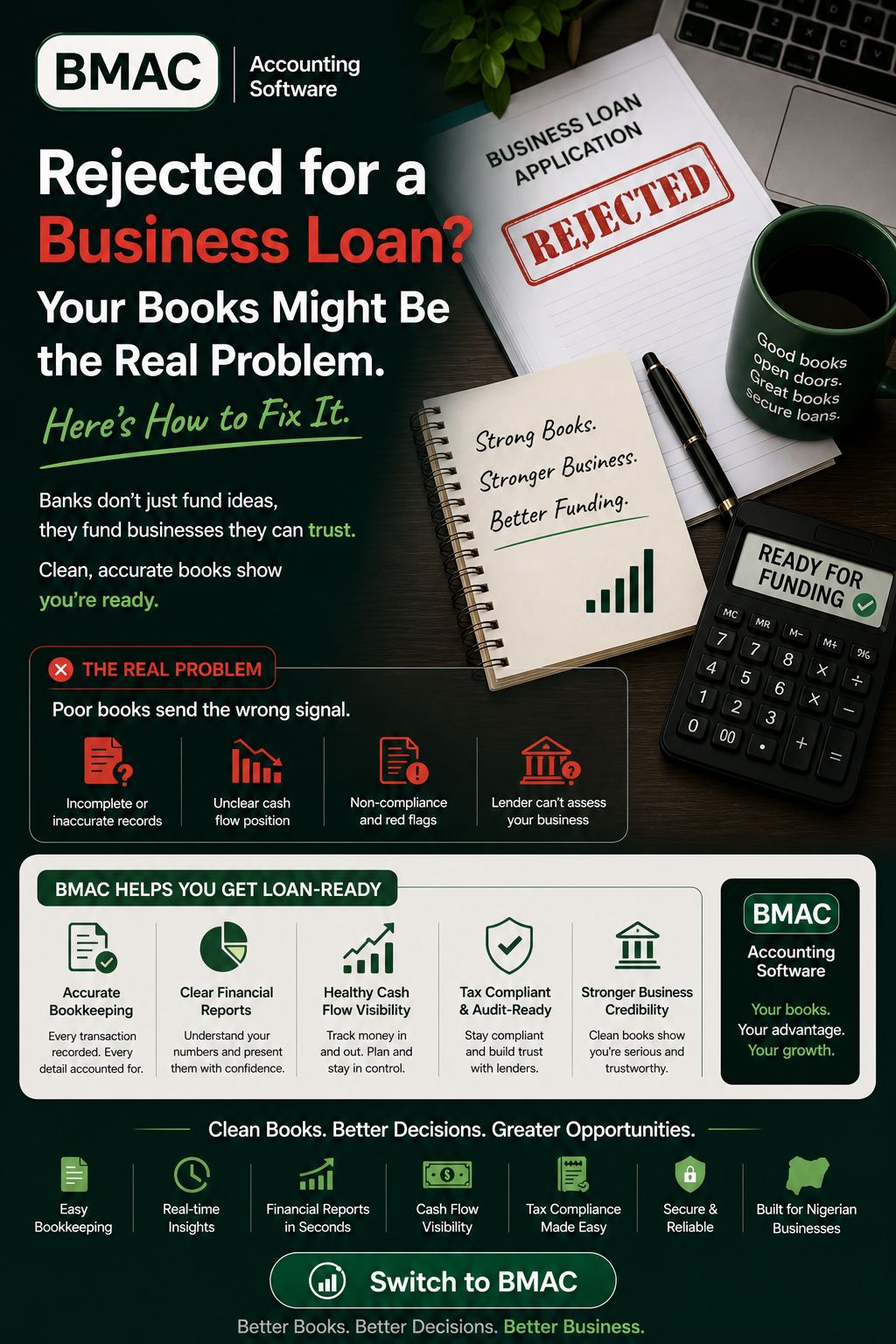
Rejected for a Business Loan? Your Books Might Be the Real Problem. Here’s How to Fix It
Getting turned down for a business loan can feel frustrating
especially when you know your SME has potential. But here’s the uncomfortable
truth, lenders don’t reject businesses based on passion or ideas. They reject
based on risk, and your financial records are the clearest measure of that
risk.
If your books aren’t telling the right story, your chances
of securing funding drop no matter how promising your business is.
Let’s break down why your accounting might be holding you
back and how to fix it.
Why Lenders Care More About Your Books Than Your Pitch
Banks and financial institutions aren’t just looking for
businesses that can grow. They’re looking for businesses that are:
Financially stable, well-managed, transparent, capable of
repayment.
Your financial records are proof of all four.
When those records are incomplete, inconsistent, or unclear,
lenders see uncertainty and uncertainty is expensive.
The Real Reasons Your Books May Be Getting You Rejected
1. Your Records Are Incomplete or Disorganized
If your financial data is scattered across notebooks,
WhatsApp messages, or multiple spreadsheets, it becomes difficult to present a
clear picture of your business.
What lenders see: confusion and lack of structure.
2. You Can’t Clearly Show Your Cash Flow
Many SMEs focus on revenue but ignore cash flow. Yet lenders
want to know one thing: Can you repay this loan consistently?
If you can’t show how cash moves in and out of your
business, that’s a major red flag.
3. Your Numbers Don’t Add Up
Inconsistent figures, missing entries, or estimates instead
of actual data can quickly destroy credibility.
What lenders think: if the numbers aren’t reliable,
neither is the business.
4. No Proper Financial Statements
If you don’t have up-to-date, Profit & Loss statements,
balance sheets, cash flow reports, then you’re essentially asking lenders to
take a blind risk.
5. You Lack Financial Insight
Even with data, if you can’t explain your margins, expenses,
or growth trends, lenders may assume you’re not in control of your business.
The Hidden Cost of Poor Bookkeeping
Bad accounting doesn’t just affect loan approvals, it
affects your entire business:
- You
make decisions based on guesswork
- You
miss early warning signs of financial trouble
- You
underprice or overspend
- You
lose investor confidence
In short, poor books don’t just block funding, they slow
growth.
How BMAC Accounting Software Helps
Instead of struggling with manual records or complex
spreadsheets, BMAC Accounting Software helps SMEs:
- Automate
bookkeeping and reduce errors
- Track
income and expenses in real time
- Generate
professional financial reports instantly
- Monitor
cash flow with clarity
- Prepare
for loan applications with confidence
With BMAC, your books stop being a liability and become a
powerful tool for growth.
Final Thoughts
If you’ve been rejected for a business loan, don’t assume
it’s the end of the road. More often than not, it’s a signal not a verdict.
A signal that your financial records need attention.
Fix your books, and you fix how lenders see your business.
And when your numbers start telling a clear, confident story, funding becomes a
lot easier to access.
Because in business, it’s not just what you say that matters,
it’s what your numbers prove and that is more reason you should get started
with BMAC today and enjoy 30 days freemium.
Click the link onebmac.com and
sign up today.

Top Related Post
Business - SME
Rejected for a Business Loan? Your Books Might Be...
Business - SME
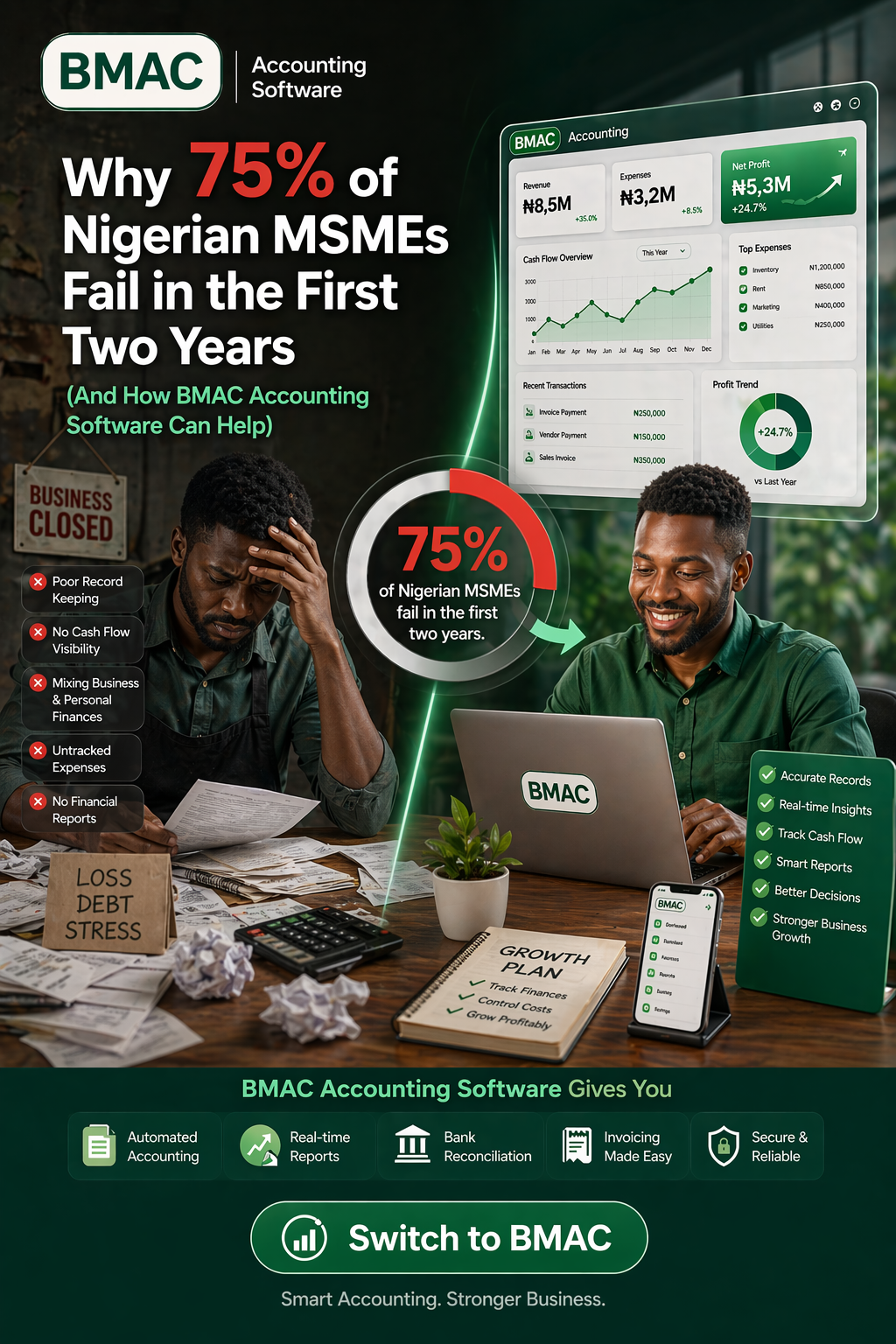
Why 75% of Nigerian MSMEs Fail in the First Two Ye...
Business - SME
The True Cost of Manual Accounting: How Nigerian S...
Business - SME
Why Record Keeping Is a Major Challenge for Nigeri...
Business - SME
Securing Your Financial Future: Why BMAC Accountin...
Business - SME
Maximising Business Profitability through Cost Man...
Business - SME
How To Plan Your Financial Future Using Cash Flow...
Business - SME
Essential Key Performance Indicators Every Small B...
Business - SME
Common Mistakes Small Business Owners Make & How t...
Featured Posts
-
-
-
29 APR, 2026
Rejected for a Business Loan? Your Books Might Be...
-
-
-
Latest Posts
-
-
-
-
 11 MAY, 2026
7 Reasons Banks Reject SME Loan Applications (And...
-
-