Business - SME
The True Cost of Manual Accounting: How Nigerian SMEs Lose Millions to Errors
For many small and medium-sized enterprises (SMEs) in Nigeria, manual
accounting feels like the cheaper option. A notebook, Excel sheet, or basic
ledger seems harmless until the hidden costs begin to pile up.
The truth? The cost of manual accounting in Nigeria is not just
about time, it’s about lost money, missed opportunities, compliance risks, and
ultimately, business failure.
Let’s break down how Nigerian SMEs are quietly losing millions every year and also show you the hidden expenses of manual accounting.
The Hidden Expenses of Manual Accounting
1. Costly Errors That Add Up Over Time
Human error is an undeniable aspect of manual accounting. Mistakes in
data entry, calculations, or record-keeping can result in discrepancies that
may go unnoticed until they escalate into major issues. These errors can lead
to:
- Incorrect
Financial Statements: Misleading financial data can
affect decision-making and lead to poor business strategies.
- Tax Penalties: Errors in tax
calculations can result in fines and penalties from regulatory bodies,
putting additional financial strain on SMEs.
- Duplicate
entries
- Missing
transactions
- Wrong
calculations
- Misclassified
expenses
Studies show that manual financial processes can have error rates of
3–5%, compared to less than 0.1% in automated systems.
A typical Nigerian SME handling transactions manually can spend up to
15 hours weekly on bookkeeping and reconciliation, translating to nearly
₦2 million annually in administrative costs alone.
Even a small 3% error margin in a ₦10 million business equals ₦300,000
lost, often unnoticed.
👉 What looks “cheap”
is actually expensive.
2. Lost Opportunities
When financial records are inaccurate or outdated, businesses may miss
out on crucial opportunities. For instance, incorrect cash flow management can
hinder a company's ability to invest in new projects or take advantage of
market trends. This stagnation can be detrimental in a competitive landscape.
Many SMEs spend 3–5 days every month reconciling accounts manually,
leading to delays in decision-making and cash flow management.
In Nigeria, over 50% of SMEs experience prolonged cash flow gaps,
often due to poor tracking systems.
3. Poor Financial Visibility = Wrong
Decisions
One of the biggest hidden costs of manual accounting is bad
decision-making.
When records are incomplete or inaccurate:
- Business owners
confuse revenue with profit
- Expenses are
underestimated
- Pricing becomes
guesswork
Many Nigerian SMEs operate with fragmented records—sales in WhatsApp,
expenses in notebooks, and payments in bank alerts, making real financial
insight almost impossible.
The result?
👉 Businesses look
busy but are actually losing money.
4. Time Drain
The time spent on manual accounting tasks is time not spent on core
business operations. Entrepreneurs and managers often find themselves bogged
down with spreadsheets and ledgers instead of focusing on growth strategies,
customer engagement, and innovation.
5. Compliance Risks and Financial
Penalties
Manual accounting makes it difficult to keep up with:
- Tax filings
- VAT
calculations
- Regulatory
compliance
Poor record-keeping means late filings, incorrect tax submissions, audit
failures
Many SMEs struggle to meet regulatory requirements because their systems
are unstructured and error-prone.
👉 The cost?
Penalties, fines, and reputational damage.
The Ripple Effect of Errors
1. Customer Trust
Errors in invoicing or billing can damage customer relationships. When
clients receive incorrect statements or delayed invoices, it can lead to
frustration, eroding their trust in the business.
2. Reputation Damage
A company’s reputation is invaluable. Frequent accounting errors can harm
a business’s credibility, making it challenging to attract new clients or
retain existing ones.
3. Financial Monitoring Challenges
Manual accounting makes it difficult to monitor financial health
accurately. SMEs may struggle to keep track of cash flow, expenses, and
profits, leading to poor financial management and planning.
Embracing BMAC Accounting Solutions: A Solution to High Costs
In contrast to the high cost of manual accounting in Nigeria, adopting
BMAC automated accounting solutions can provide numerous benefits:
- Accuracy: Automation
reduces the risk of human error, ensuring more reliable financial data.
- Efficiency: Automated
systems streamline accounting processes, saving time and allowing
businesses to focus on growth.
- Real-Time Data
Access: Business owners can access up-to-date financial information,
facilitating better decision-making.
- Cost Savings: While there may be initial setup costs for automated systems, the long-term savings from reduced labor costs and fewer errors can be substantial.
Final Thought
If your business still relies on manual accounting, you’re not saving
money, you’re paying for inefficiency in disguise.
In today’s fast-moving Nigerian economy, the question is no longer:
“Can I afford accounting software?”
It’s:
👉 “Can I afford
the cost of manual accounting in Nigeria?”
Manual accounting doesn’t just cost money; it silently limits growth.

Top Related Post
Business - SME
Rejected for a Business Loan? Your Books Might Be...
Business - SME
Why 75% of Nigerian MSMEs Fail in the First Two Ye...
Business - SME
The True Cost of Manual Accounting: How Nigerian S...
Business - SME
Why Record Keeping Is a Major Challenge for Nigeri...
Business - SME
Securing Your Financial Future: Why BMAC Accountin...
Business - SME
Maximising Business Profitability through Cost Man...
Business - SME
How To Plan Your Financial Future Using Cash Flow...
Business - SME
Essential Key Performance Indicators Every Small B...
Business - SME
Common Mistakes Small Business Owners Make & How t...
Featured Posts
-
-
-
 29 APR, 2026
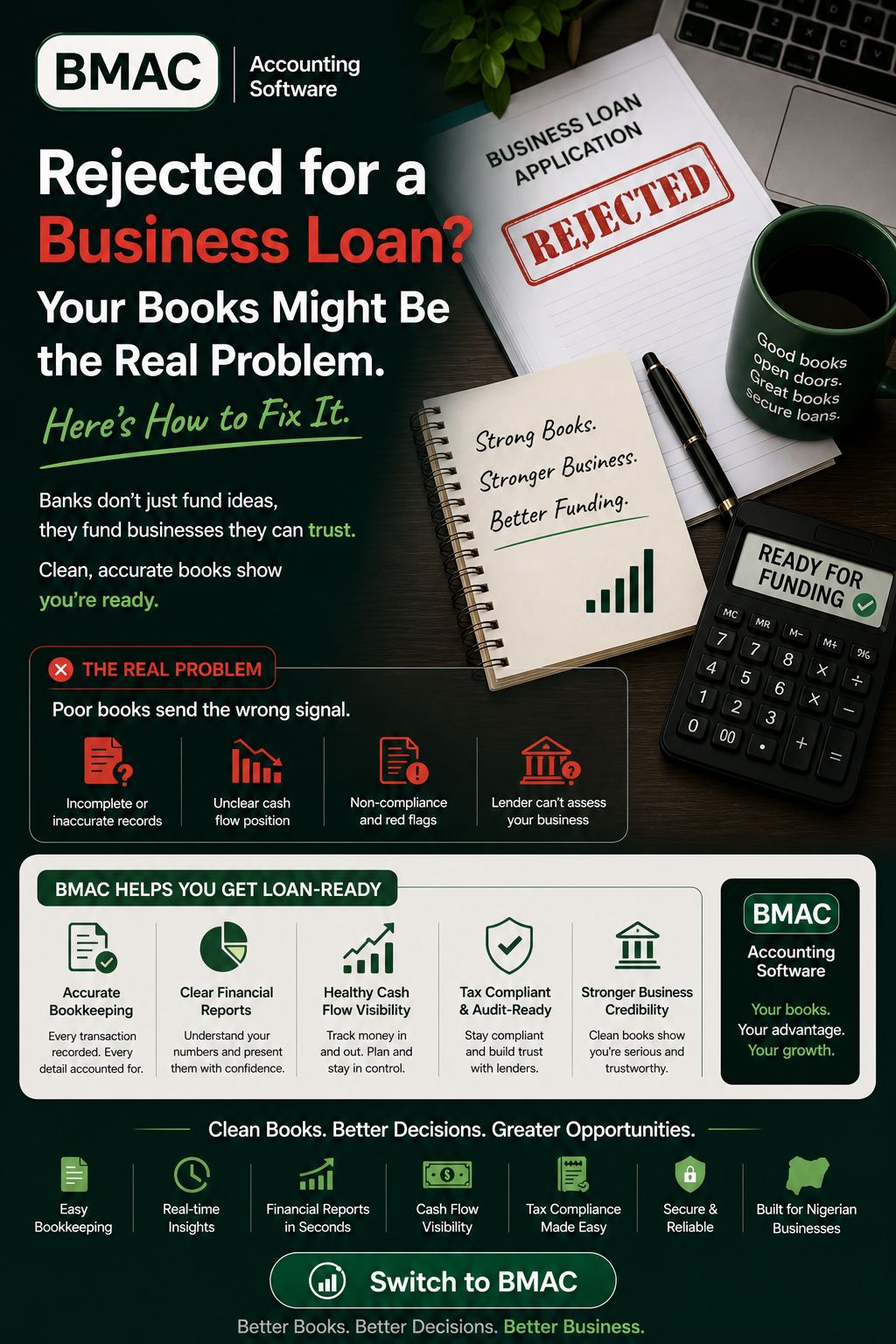
Rejected for a Business Loan? Your Books Might Be...
-
-
-
Latest Posts
-
-
-
-
 11 MAY, 2026
7 Reasons Banks Reject SME Loan Applications (And...
-
-